Debt Planning That Works With Your Retirement Goals
Pay off debt strategically while still building your retirement nest egg—no judgment, just smart guidance
Most retirement calculators ignore debt. Most debt payoff tools ignore retirement. We bring them together. Our AI helps you find the right balance between paying down debt and saving for your future, using proven strategies tailored to your situation.
Key Features
Snowball vs. Avalanche Analysis
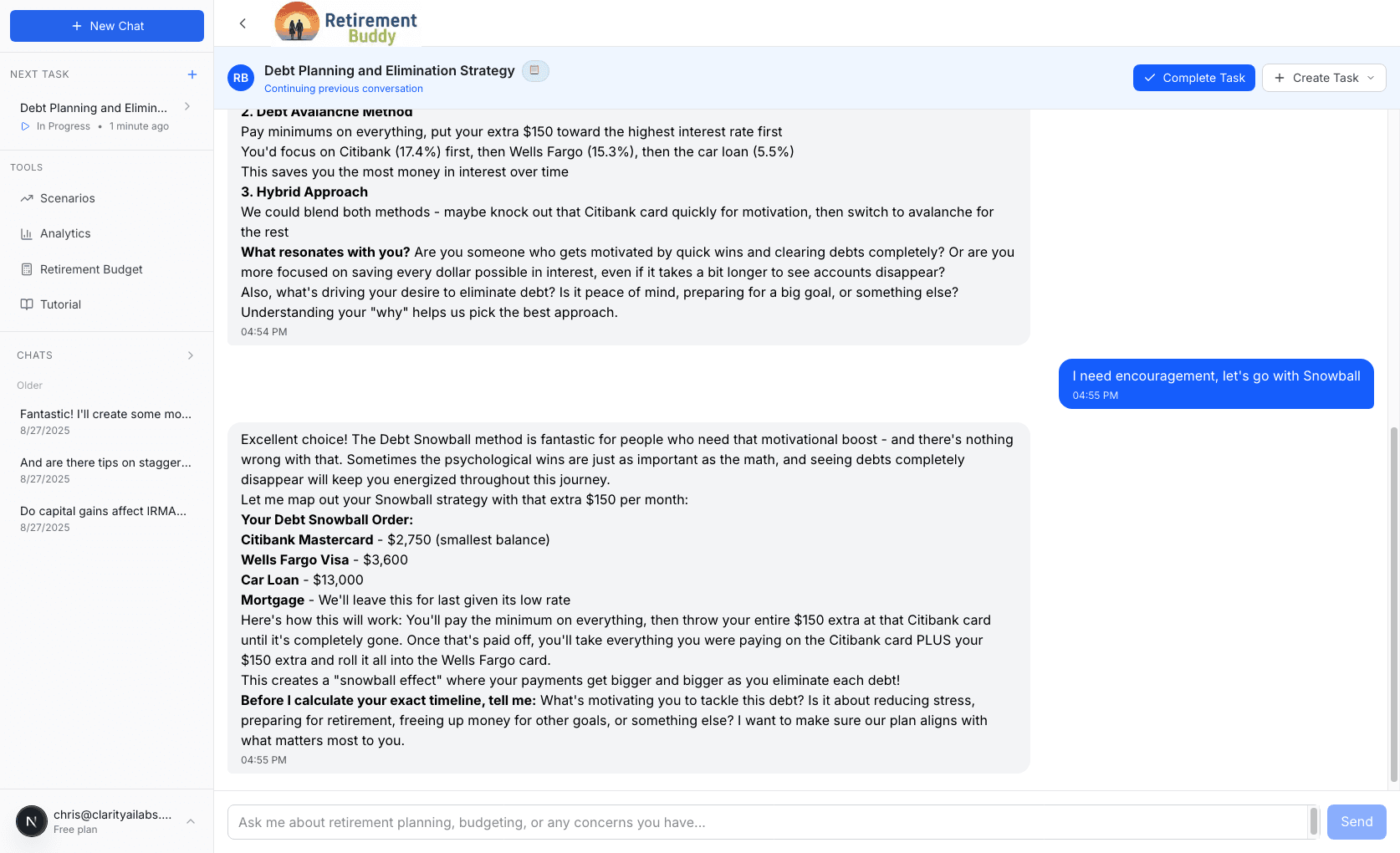
Compare debt payoff strategies side-by-side. See exactly how much you'll save with avalanche (highest interest first) vs. the motivational wins of snowball (smallest balance first).
Retirement Integration
Understand the trade-offs: pay extra on debt or contribute more to 401(k)? We calculate the math and show you the long-term impact of each choice.
Balanced Approach
Our AI recommends the optimal split between debt payoff and retirement savings based on interest rates, employer match, and your timeline.
Judgment-Free Guidance
No shame, no lectures. Whether it's credit cards, student loans, or a mortgage, we help you make progress without sacrificing your future.
Dynamic Adjustments
As you pay down debt or your income changes, we automatically recalculate your optimal strategy and retirement projections.
Payoff Timeline Modeling
See exactly when each debt will be paid off and how different payment amounts accelerate your timeline.
Why It Matters
Make informed decisions about debt vs. retirement savings with clear math
Maximize your financial progress by optimizing debt payoff strategy
Never miss employer 401(k) match while paying down high-interest debt
See the real long-term impact of paying off debt early on retirement security
Get personalized recommendations based on your specific debt mix and goals
Automatically adjust your plan as debts are paid off or circumstances change
How You'll Use It
High-Interest Credit Card Debt
You have $15,000 in credit card debt at 22% APR and wonder if you should pause 401(k) contributions. Our AI shows you: paying minimums while keeping employer match gets you ahead long-term. The compound growth of matched contributions outweighs the interest cost. But once you're past the match, every extra dollar should attack that 22% debt.
Student Loans vs. Retirement
$45,000 in student loans at 5% APR, age 28. Should you aggressively pay them off or invest in retirement? We model both scenarios: avalanche payoff clears debt by 35 but delays retirement savings. Balanced approach (minimum payments + max employer match) leaves you $180,000 richer at 65 despite carrying debt longer. The right choice depends on your risk tolerance—we help you see the trade-offs clearly.
Refinancing Decisions
Considering refinancing your mortgage to a 15-year at a lower rate? We show you how the higher payments affect your retirement contributions and long-term wealth. Maybe the extra $500/month would compound to $300,000 in your 401(k). Or maybe paying off the house by 55 gives you the security to retire early. Our simulations reveal what works for your goals.
Debt-Free vs. Retirement-Rich
You're 45 with $80,000 in various debts and minimal retirement savings. Feeling like you should pay off everything before thinking about retirement? We run the numbers: even modest retirement contributions now, while making strategic debt payments, can mean the difference between working to 70 or retiring at 65. It's not about choosing one or the other—it's about finding your optimal balance.
Ready to Experience Debt Planning?
Start your journey to retirement confidence today—no credit card required
Get Started Free